A flush outranks a straight in standard Texas Hold’em. Balatro borrows those hand names, but a label alone cannot tell you the final score. Its card patterns feed a calculation that changes with upgrades and modifiers. Understanding the difference means separating three questions: what combination have you made, how would it rank against another poker hand, and what does Balatro do with it?
In his 2025 development timeline, LocalThunk records that the prototype already multiplied Chips by Mult at the end of December 2021. Mult is the game’s multiplier. Jokers were added in February 2022. The scoring system came first, with modifiers developing around it afterward. Hands already produced a numerical result, rather than deciding a winner by comparing one player’s cards with another’s.
How a poker hand is compared
Standard Texas Hold’em compares hands by category before considering individual card ranks. A full house, made from three cards of one rank and two of another, beats a flush. A flush beats a straight, and a straight beats three of a kind. Those relationships stay fixed from one deal to the next. At showdown, the players still contesting the pot reveal their hands after the final betting round. In online poker games, a Hold’em showdown compares the players’ best five-card hands using that fixed order.
Each player receives two private cards, called hole cards, and can use the five community cards on the table. Once all five community cards are present, you form the strongest five-card hand from the seven available cards. It can use both hole cards, one, or neither. Holding a card privately does not force it into the final five, and the two unused cards cannot break a tie.
Within a category, the relevant card ranks settle the comparison. For two one-pair hands, compare the pairs first, then the unpaired cards from highest to lowest if needed. These remaining cards are called kickers. Suits have equal standing: spades do not beat hearts or vis versa. If the best five-card hands are equal in rank, the players tie.
Balatro turns the hand into a calculation
Balatro starts with a hand type’s base Chips and Mult. Multiplying the completed Chips total by the completed Mult gives the score for that play. The base values are only the beginning: scoring cards contribute chips, and applicable effects can adjust Chips, Mult, or both. The score contributes toward the current blind, Balatro’s name for a challenge with a chip target. You are trying to reach that target within the available hands, rather than establish that your cards outrank another player’s holding at a showdown.
Hand levels add another difference. In ordinary Hold’em, a pair does not become stronger because you have played pairs in previous hands. Balatro lets you level up hand types through Planet cards, changing their base values during the run. A familiar category can have a different scoring starting point later, even though its card pattern has not changed.
Jokers sit separately from the playing cards you select. Their effects can reward particular suits, ranks, or combinations, or change how a hand scores. The relevant question is which effects trigger during the current play. Some effects also come from cards you keep in hand, so the score need not depend solely on the cards you play.
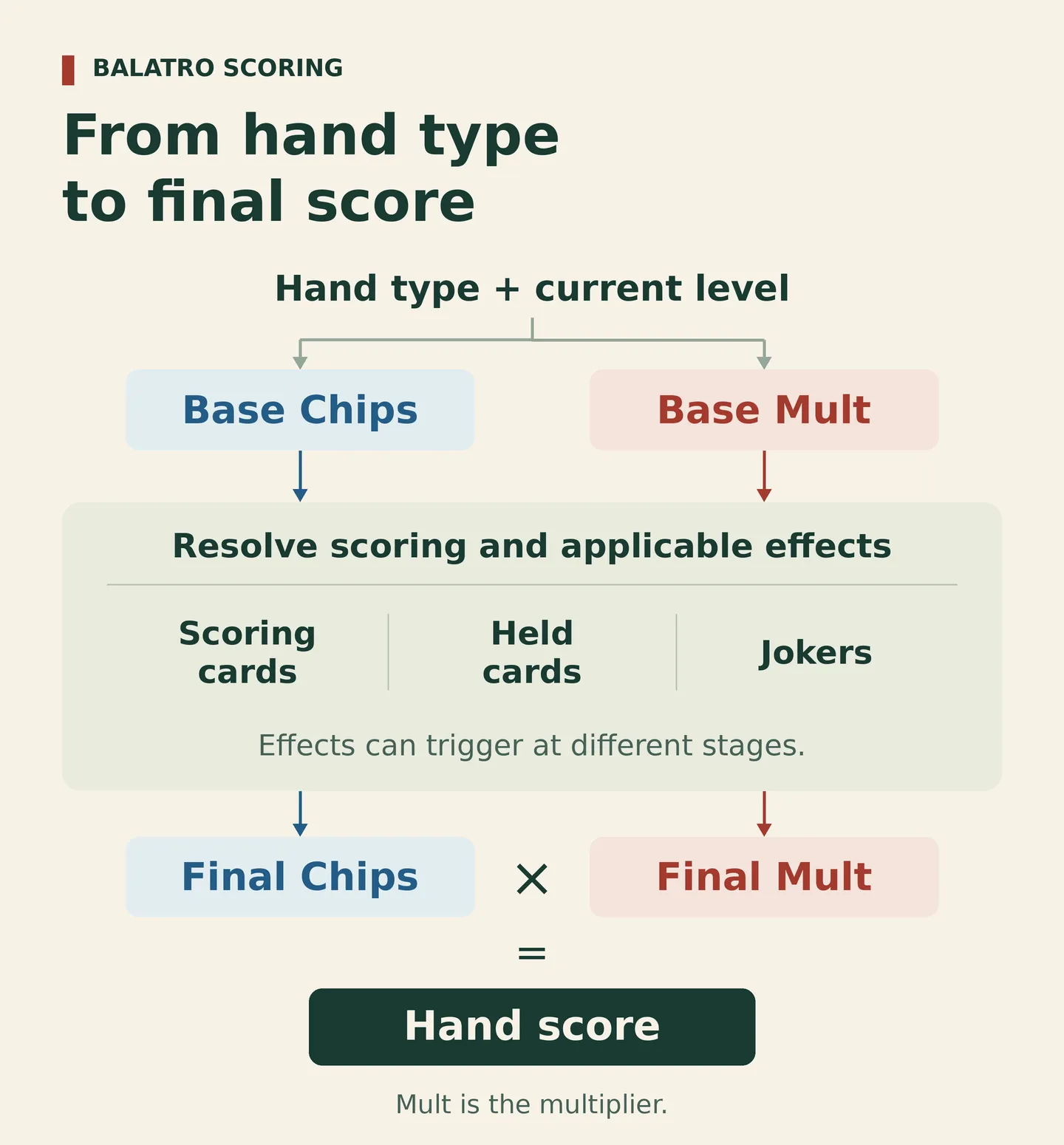
Balatro also distinguishes cards you play from cards that actually score. Without a relevant special effect, a pair scores its paired cards, rather than treating the other played cards as poker kickers. Those extra cards do not decide a tie with an opponent. In Hold’em, the unpaired cards within a one-pair hand can decide the result.
Adding to Mult and multiplying Mult are different operations. One increases the current multiplier by a stated amount; the other scales the multiplier already accumulated. The plus or multiplication sign on an effect carries information that the word “Mult” alone cannot convey.
| Comparison | Standard Texas Hold’em | Balatro |
| What is evaluated | Best eligible five-card hand | Score produced by a played hand |
| Hand category | Position in a fixed ranking | Base Chips and Mult at its current level |
| Modifiers | No Joker effects or hand upgrades | Applicable effects alter scoring |
What a digital poker game preserves
A poker game can move to a screen while keeping its original rules. Press Play Media’s March 2026 review of Poker Night at the Inventory describes No Limit Texas Hold’em played as a tournament, with players calling, raising, and folding until one remains. Familiar characters and dialogue surround a contest that still involves responding to other participants.
At showdown, a lower-ranked hand cannot overtake a higher-ranked hand through a collected upgrade. Hands can also end before a showdown when only one player remains in contention. Card rankings settle comparisons, while betting and folding determine whether those comparisons happen.
Knowing what a straight or full house looks like helps you recognize combinations in both games. In Hold’em, the next task is to select the best five cards and apply the ranking and tie-breaking rules. In Balatro, it is to account for the hand’s level and the applicable scoring effects. A poker ranking chart can resolve the first task. It cannot replace reading Balatro’s current hand levels and the effects attached to the cards in play.