


A casino simulator can look busy and still feel thin. The room may have glowing machines, tables, dealers, guests, bars, upgrades, and staff routes, but players notice when every object behaves like decoration. The deeper question is not how many casino items fit on the floor. It is whether those items create different ways to play.
That is why player agency matters in this genre. Sarah Stang’s Game Studies essay on interactivity and player agency argues that games often create a sense of control through the choices they let players make, limit, or reinterpret. Casino simulators sit right in that tension. They promise a place full of recognizable activities, then sometimes reduce those activities to management symbols. A poker table is not only a table. A slot bank is not only a management object. A lounge is not only an empty space with seats.
The Floor Is Only the First Layer
A stronger casino sim understands that players read each area differently. Poker suggests timing, observation, and decision pressure. Slots suggest short loops, theme recognition, sound, and quick feedback. Jackpot formats add another layer because they make category, anticipation, and game identity more visible. This is where selections of online jackpot games become a useful real-world reference for how one casino category can carry its own texture.
The page presents jackpot slots as a distinct group, with progressive jackpot titles, Hot Drop formats, hourly and daily jackpot labels, and practice-mode wording around game exploration. For a simulator designer, the lesson is not to copy the page. It is to notice how online jackpot games are framed as a specific style of play, not a generic machine cluster. A casino sim can borrow that clarity by making each area feel different in pace, feedback, and player expectation. If every table, machine, and social space produces the same management action, the setting loses personality. If each one creates a slightly different rhythm, the floor starts to feel like a place players want to understand.
A quick SlotsLV Instagram poll asking users where they would be found, with choices for bar, poker table, or slots, shows the same idea in a simpler form. The post works because the question is easy, but the answers carry identity. One player imagines atmosphere. Another imagines cards. Another goes straight to machines. Casino sims often miss that emotional shorthand. They show the objects, but not always the reason a player would choose one over another.
View this post on Instagram
What Different Casino Areas Promise
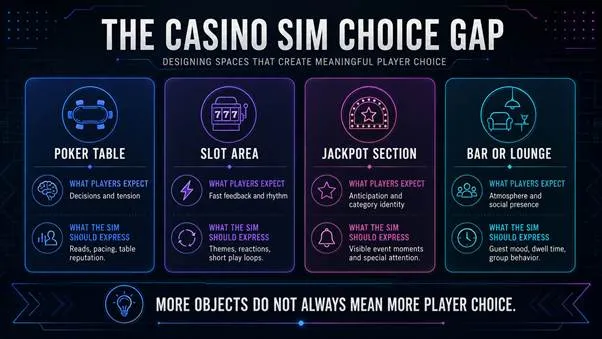
This does not mean every simulator needs playable poker hands, full slot mechanics, or detailed social systems. The better lesson is proportional design. A casino management game can stay focused on building, hiring, upgrading, and layout while giving certain areas a clearer feel. Even small differences matter when they change how the player interprets a choice.
Why Shallow Choice Feels So Noticeable
Players can accept abstraction when the game is honest about it. In a hospital sim, nobody expects a full medical procedure. In a city builder, nobody expects to personally drive every bus. Casino sims are different because their objects already belong to playable traditions. People know what cards, reels, wheels, and jackpots usually imply. When those objects become passive scenery, the mind fills in the missing play and then notices the gap.
In general, casino simulators let players place poker tables and manage the business side, while poker itself remains part of the broader tycoon structure. That choice can work, but it also shows the genre’s central design trade-off. The more recognizable the activity, the more players expect it to behave with its own logic.
The Next Step For Casino Sims
The future of casino sims probably is not “make every object playable.” That would turn a management game into several smaller games stitched together. The smarter path is selective depth. Give key areas verbs, not just values. Let the player host, adjust, observe, trigger, compare, or respond. A machine zone could change the floor’s tempo. A poker area could attract a different guest profile. A jackpot section could create short bursts of attention without taking over the whole sim.
The best casino simulator will be the one that knows when a player wants to manage from above and when they want to feel closer to the table. That balance is hard, but it is also where the genre becomes more interesting. Objects create the room. Mechanics create the memory. The research chapter What Is a Game Mechanic? is useful here because it shows how widely the term can be defined across game studies, from player actions and rule systems to the tools that shape interaction with a game world. For casino sims, that distinction matters. The genre does not need more floor items alone. It needs clearer ways for players to act on the spaces they build, with choices that feel specific, readable, and worth revisiting as the casino grows over time.




